
Introduction: The Map of Your Neurons
These scientific study hacks will change the way you learn forever. Have you ever wondered why you remember a song from ten years ago but forget what you read five minutes ago? Learning is not about time, but about biology and how you apply specific scientific study hacks to your daily routine. Science shows that your brain is like a muscle that needs specific tension and recovery to grow. Within this post, we explore how biology and technique combine to create the ultimate learning system.
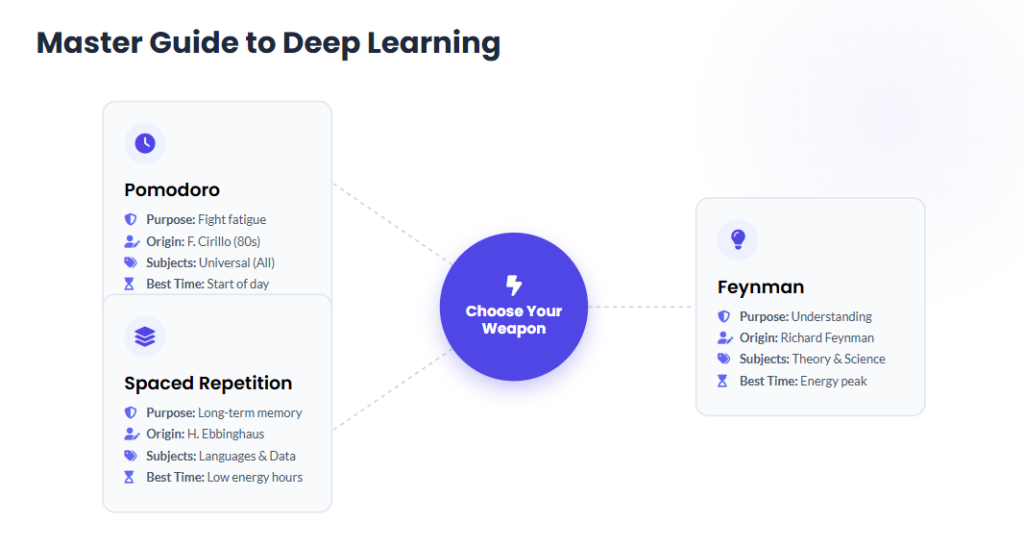
1. Chronotypes and Scientific Study Hacks
Implementing scientific study hacks is impossible if you fight your natural biological rhythm. Your circadian rhythm dictates when your cortisol levels (the alert hormone) peak throughout the day.
- The Curiosity: “Larks” (morning people) reach peak focus at 10:00 AM. In contrast, “Owls” (night people) find mental clarity after 6:00 PM.
- Specifically: Fighting this creates “social jet lag.” This habit reduces your memory retention by up to 30%. Do not force yourself to wake up early if your brain shines at night. Effective science means working with your body.
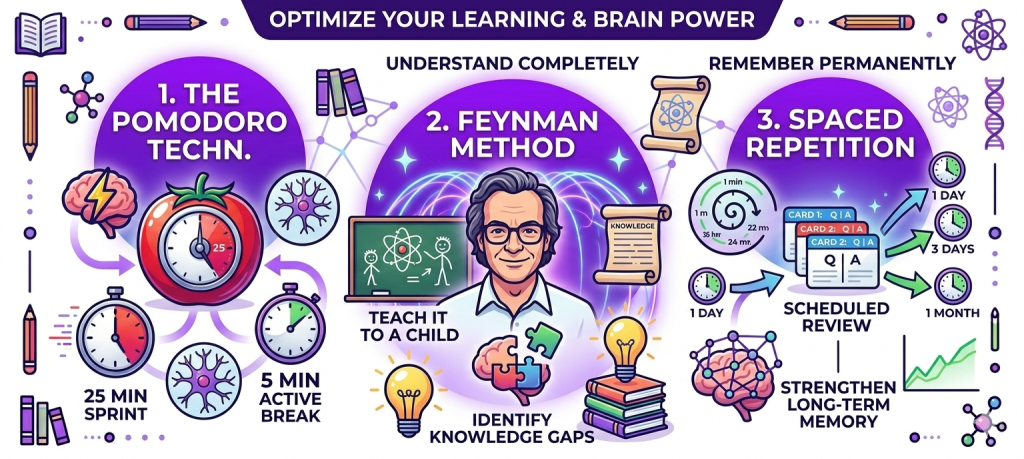
2. The Pomodoro Scientific Study Hacks
Think of the Pomodoro technique as one of the most practical scientific study hacks to prevent your prefrontal cortex from burning out. This method is universal and vital for tasks that feel boring or heavy.
Step-by-Step Execution:
- Strategic Planning: Begin by choosing one single task and break it into small, manageable pieces.
- The Focused Sprint: Set a 25-minute timer and let the world disappear. If a distraction pops up, write it down and return to focus.
- Active Recovery: Take a 5-minute break away from screens. Whether you stretch or drink water, this prevents the brain from “habituating” to the task.
- Free Tool: Pomodoro Timer
3. Feynman Method: Scientific Study Hacks for Mastery
Theory-heavy subjects require these scientific study hacks to ensure true understanding. It follows one rule: if you cannot explain it simply, you do not truly understand it.
Step-by-Step Execution:
- Teach a Child: Start by writing an explanation of the topic as if you were talking to a 10-year-old. You must avoid technical jargon.
- Pinpoint Knowledge Gaps: Whenever you get stuck, you have found a weak link. Go back to the source material only for that specific part.
- Build a Solid Analogy: Try comparing the concept to something real. Specifically, this makes knowledge “sticky” and easier to retrieve later.
- Free Tool: Miro
4. Spaced Repetition: Programming Your Memory
Memorizing pure data requires specific scientific study hacks like Spaced Repetition. It attacks the Forgetting Curve by reminding you of info just before it leaves your mind.
Step-by-Step Execution:
- Smart Creation: Develop “Flashcards” with a question on the front and the answer on the back.
- The Time Ladder: Review the cards today, then again in 2 days, 10 days, and 30 days.
- The Neural Result: This process strengthens synaptic connections, moving information into your long-term memory.
- Free Tool: AnkiWeb
5. The Highlighter Myth and Digital Silence
Many students love coloring books, but neuroscience calls this the “Illusion of Competence.” A better scientific study hack is Dual Coding: draw a small icon or diagram in the margin to create two memory paths instead of one.
Also, avoid Attention Residue. Checking your phone for only 5 seconds stays in your brain for 20 minutes. While modern tools can be distracting, they are also revolutionary. For instance, understanding the history of ChatGPT reveals how AI has transformed into a powerful study assistant when used alongside these scientific study hacks.
Washington’s Academic Edge: Local Success
Applying these scientific study hacks is exactly what students at top-tier institutions like the University of Washington (UW) or Washington State University (WSU) do to stay ahead in competitive fields. Whether you are studying at the Suzzallo Library in Seattle or a local coffee shop in Spokane, the environment matters. Washington’s unique climate—with its rainy study-perfect afternoons—is the ideal setting to master the Pomodoro technique or the Feynman method. Success in the Pacific Northwest is built on science-backed routines.
Your Legacy of Knowledge: Rewrite Your Future
These scientific study hacks are more than just tips; they are the keys to a kingdom of infinite possibilities. Every minute you invest in understanding your mind is a brick in the foundation of the greatness you are destined to achieve. You are no longer a passive student of life; you are now the architect of your own intelligence.
The path to mastery is right in front of you. It’s time to stop surviving your exams and start conquering your dreams. Grab your tools, silence the noise, and show the world what you are truly capable of. Your future self is already cheering for you—don’t keep it waiting!
Wait… Is Your Brain Truly Ready for the Next Level? You now have the scientific map to conquer any exam. However, there is one invisible factor that could still sabotage your progress. Are you curious about the “Sleep-Learning” paradox? Stay tuned, because your journey to mastery has only just begun.