
Essentially, Precision Robotics represents the most significant leap in medical technology since the dawn of anesthesia. Historically, surgery began as a brutal necessity—often involving trepanation to release perceived “demons” from the skull. However, today’s landscape looks vastly different. This study explores how Precision Robotics revolutionized surgical technology, tracking our progress from blacksmith-style hacks to the surgical perfection of the 21st century.
The Precision Robotics Telemetry Shift
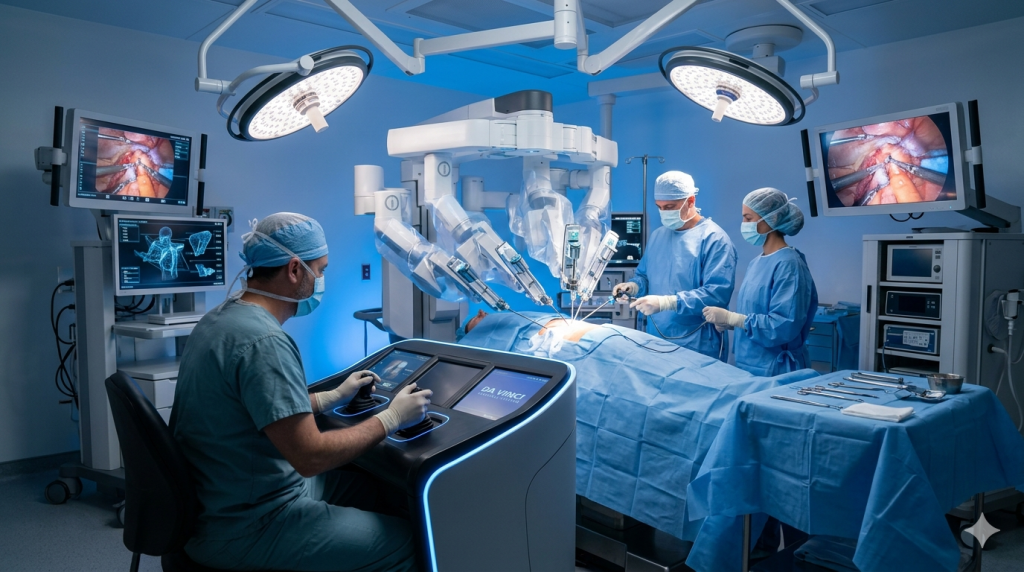
In my opinion, surgery transitioned from “removing failed parts with manual tools” to an exercise in high-precision telemetry. Honestly, I still suspect that Precision Robotics systems maintain lower input lag than their human counterparts. Furthermore, the robot does not suffer from fatigue or pulse jitters induced by caffeine. Consequently, surgery has become a data-driven process where the surgeon acts as the lead operator of an advanced interface.
The Current Arsenal: Types of Precision Robotics
Currently, surgeons rely on interfaces rather than direct manual manipulation for critical procedures. Notably, Precision Robotics tools are standard in the following areas:
- Urology & Gynecology: The Da Vinci system dominates prostatectomies and hysterectomies.
- Cardiothoracic Surgery: Surgeons perform valve repairs and coronary revascularizations via minimally invasive techniques.
- General Surgery: Specialists execute colon resections and complex hernia repairs with high mechanical efficiency.
- Robotic Neurosurgery: Robotic arms perform brain biopsies with micrometer precision—a level of detail that human hands cannot physically match.
The Global Hubs: Who is Leading the Precision Robotics Code?
Globally, several regions drive the development of these systems. For example:
- United States: Acts as the primary pioneer in Da Vinci system adoption and telesurgery standardization.
- South Korea: Leads the world in robotic surgery adoption per capita, integrating these protocols into public health systems rapidly.
- Germany & France: Serve as centers of excellence for researching new robotic effectors and real-time image-assisted surgery.
Cost Analysis: The Price of Superhuman Precision
Financially, a robotic surgery costs between 20% and 40% more than a conventional laparoscopic procedure. Admittedly, this price increase stems from equipment maintenance, disposable arms with programmed usage limits, and intensive staff training. As Greg puts it: “They call it ‘operating cost,’ I call it a ‘human error tax.’ You pay more because the manufacturer guarantees that you will not need to re-enter the operating room to patch a failure.”
The Convergence: An Engineering Ecosystem
Modern surgery functions as a technical ecosystem rather than just a medical practice. Specifically:
- Robotics & Mechanical Engineering: Governs the design of end-effectors and arm kinematics.
- AI & Image Processing: Removes natural surgeon tremors and enhances 3D visualization.
- Materials Science: Develops polymers that prevent friction and tissue degradation.
- Telecommunications: Dictates the feasibility of telesurgery, where network latency remains the critical constraint.
The eSports Connection
The required skill set today is distinctly digital, bridging the gap between surgery and gaming. As I often note, a modern surgeon’s dexterity increasingly resembles that of a professional eSports player. Indeed, when one spends 10 hours a day moving joysticks to operate on a heart, the line between a surgeon and a pro-gamer effectively vanishes. Therefore, both professionals resolve complex problems within a virtualized environment. This digital evolution is an expansion of themes discussed in The History of Video Games.
Impact on Science & Medicine
Ultimately, this technological shift provides massive benefits. For instance:
- Reduced Trauma: Patients experience less blood loss, faster recovery, and fewer infections.
- Democratized Access: Telesurgery allows experts to operate on patients across thousands of miles, provided the server connection remains stable.
- Data Acquisition: Robotic surgeries generate terabytes of data, allowing AI to learn and optimize procedures for future patients.
In addition, for those interested in how these data-heavy environments impact our internal biological clocks, review The History of Circadian Rhythms: Hacking Your Internal Clock. Finally, for further validation of robotic benchmarks, consult the Journal of Robotic Surgery.