
The television has permanently altered how humanity consumes information and entertainment; furthermore, understanding the history of the television reveals a remarkable journey of technical innovation. Consequently, in this article, we explore the origins, the evolution of display types, and the essential components that brought images to life.
The Origins of Television Broadcasting: Early Milestones
Initially, mechanical systems pioneered the concept of transmitting images. However, the true breakthrough occurred with electronic systems. Notably, Philo Farnsworth demonstrated the first fully functional all-electronic system in 1927. Furthermore, this invention laid the groundwork for the modern era of global broadcasting. If you want to compare this to other historical advancements, we invite you to read our post on The History of the Cell Phone.
Television Evolution: From Black and White to Color Displays
Early sets displayed images exclusively in black and white. By contrast, the transition to color represented a massive leap in engineering. In fact, researchers struggled for years to develop a system compatible with existing black-and-white signals. Eventually, the NTSC standard established the framework for color broadcasting, thus allowing audiences to view the world in its full spectrum. For deep technical standards, consult the ITU Radiocommunication Sector.
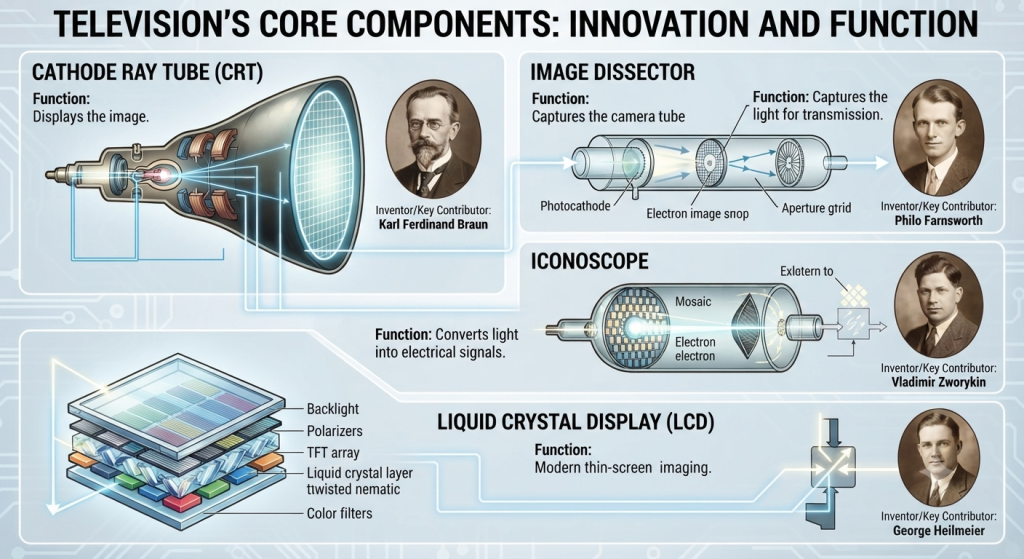
Core Components and Their Inventors
Specifically, many engineers contributed to the anatomy of the television machine. Furthermore, understanding who invented these parts clarifies the complexity behind the screen, much like the biological structures we detailed in The History of Cell Biology.
Types Through Time
Throughout the decades, television technology has evolved rapidly. It transitioned from crude mechanical origins to sophisticated digital displays. Initially, mechanical models used rotating disks to scan images. This process was cumbersome and limited in resolution. By comparison, CRT sets dominated the market during the 20th century. These bulky units featured vacuum tubes and served as the centerpiece of living rooms for generations.
As engineering advanced, the industry shifted toward sleek, efficient alternatives. Finally, modern television displays embraced flat-panel innovations like LED and OLED technologies. These screens provide high-definition experiences with vibrant color accuracy. They also maintain lower energy consumption than their predecessors. Consequently, this evolution has transformed how we perceive visual media. It makes high-quality entertainment more accessible than ever before.