
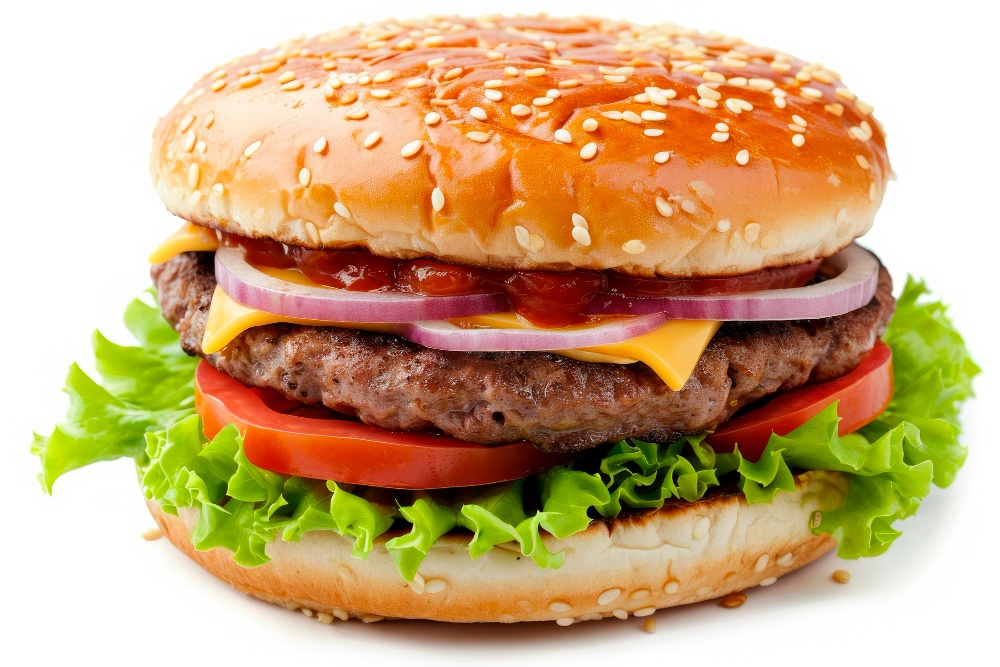
Introduction: America’s Favorite Sandwich
It’s the ultimate American food. Simple yet satisfying, the hamburger has conquered the world from its humble beginnings at state fairs and lunch counters. Today, billions of burgers are consumed annually, making it one of the most popular foods on the planet.
But the history of the hamburger is surprisingly complex and contested. Multiple people claim to have invented it, cities compete for the title of birthplace, and the journey from ground beef to global icon is filled with innovation and controversy.
Let’s sink our teeth into the delicious story of how the hamburger became an American classic.
Ancient Origins: Ground Meat Through History
The concept of ground meat isn’t new:
- Ancient Romans had a dish called “Isicia Omentata” – seasoned ground meat
- Mongols in the 13th century placed meat under their saddles to tenderize it
- German immigrants brought “Hamburg steak” (ground beef) to America in the 1800s
- This was raw or lightly cooked ground beef, eaten with a knife and fork
But the hamburger as we know it required one crucial innovation: putting it between bread.
1885-1900: The Battle for “First Burger”
Several people claim to have invented the hamburger:
- Charlie Nagreen (“Hamburger Charlie”) – Seymour, Wisconsin, 1885: Allegedly flattened a meatball and put it between bread at a county fair
- Frank and Charles Menches – Hamburg, New York, 1885: Claim they ran out of pork sausage and substituted beef at a fair
- Otto Kuase – Hamburg, Germany, 1891: Said to have invented it on a transatlantic ship
- Fletcher Davis – Athens, Texas, 1880s: Served ground beef patties at his lunch counter
- Louis Lassen – New Haven, Connecticut, 1900: Supposedly served the first burger at Louis’ Lunch
The truth? We’ll probably never know for certain. The hamburger likely evolved simultaneously in multiple places.
1904: The St. Louis World’s Fair Connection
One commonly cited origin story:
- Fletcher Davis allegedly served hamburgers at the 1904 World’s Fair in St. Louis
- The Fair introduced many American food icons (ice cream cone, hot dog, peanut butter)
- Millions of visitors were exposed to the hamburger
- Whether Davis truly “invented” it is debated, but the Fair spread awareness
The World’s Fair was a crucial moment in hamburger popularization.
1921: White Castle Creates Fast Food Culture
The game-changer came from Wichita, Kansas:
- Billy Ingram and Walter Anderson opened the first White Castle in 1921
- It was the first hamburger chain in America
- Burgers cost 5 cents – cheap, fast, and consistent
- White Castle pioneered: standardized cooking, assembly-line production, take-out service
- The clean, white buildings combated the perception that ground beef was unsanitary
White Castle’s “Sliders” created the template for all fast food that followed.
1940s: Drive-Ins and the California Burger Scene
Post-WWII America fell in love with cars and burgers:
- Drive-in restaurants combined American car culture with quick meals
- McDonald’s started as a drive-in in San Bernardino, California (1940)
- Brothers Richard and Maurice McDonald served simple, cheap burgers
- Bob Wian created the “Big Boy” double-decker burger in 1936
- California became the epicenter of burger innovation
The hamburger was becoming synonymous with American prosperity and freedom.
1955: Ray Kroc and the McDonald’s Empire
Everything changed when a milkshake machine salesman visited the McDonald brothers:
- Ray Kroc saw the McDonald’s operation and recognized its potential
- In 1955, he opened the first franchised McDonald’s in Des Plaines, Illinois
- Kroc implemented the “Speedee Service System” – ultra-efficient assembly line
- Consistency became paramount: every burger exactly the same
- By 1958, McDonald’s had sold 100 million burgers
Kroc didn’t invent the hamburger or even the fast-food concept, but he perfected and globalized it.
1960s-70s: The Burger Wars Begin
Competition heated up:
- Burger King (1954) challenged McDonald’s with flame-broiling
- Wendy’s (1969) introduced square patties and fresher ingredients
- “Have it your way” – Burger King’s 1974 slogan emphasized customization
- The Big Mac debuted in 1968, becoming McDonald’s signature item
- The Whopper (1957) and Quarter Pounder (1972) became iconic
These “Burger Wars” led to massive marketing campaigns and menu innovation.
1980s-90s: Gourmet Burgers and Health Concerns
The burger evolved in two directions:
- Upscale burger joints emerged, charging $10-15 for premium burgers
- Focus on quality ingredients: angus beef, artisan buns, exotic toppings
- Meanwhile, health concerns about red meat grew
- Fast food chains added chicken and salads to menus
- 1993 E. coli outbreak at Jack in the Box raised food safety awareness
Despite health worries, burger consumption continued rising.
2000s-Present: The Craft Burger Revolution
Modern burger culture is more diverse than ever:
- Gourmet burger chains: Five Guys (1986), Shake Shack (2004), Smashburger (2007)
- Craft burgers with unique toppings: truffle aioli, fried eggs, peanut butter
- Impossible and Beyond Meat – plant-based burgers that “bleed”
- Wagyu beef burgers costing $50+
- Food trucks specializing in creative burger concepts
- Instagram-worthy burgers stacked impossibly high
Americans spend over $100 billion annually on burgers.
Regional American Burger Styles
Different regions developed distinct styles:
- Smashburger: Thin patties smashed on a griddle (Midwest origin)
- California Burger: Lettuce, tomato, onion, avocado, sprouts
- Oklahoma Onion Burger: Onions pressed into the patty while cooking
- Juicy Lucy: Cheese stuffed inside the patty (Minnesota)
- Green Chile Burger: New Mexico’s spicy specialty
- Steakburger: Steak-cut beef, often thicker (Midwest)
The Global Hamburger Empire
The numbers are staggering:
- 50 billion burgers consumed annually in the U.S. alone
- Average American eats 3 burgers per week
- McDonald’s serves 69 million customers daily in 100+ countries
- 40% of American sandwiches sold are hamburgers
- The largest burger ever made weighed 2,014 pounds
Fascinating Hamburger Facts
- The word “hamburger” has nothing to do with ham – it refers to Hamburg, Germany
- Americans consume enough burgers annually to circle the Earth 32 times if placed side-by-side
- The most expensive burger ever sold cost $10,000 (FleurBurger 5000 in Las Vegas)
- National Hamburger Day is May 28th
- The cheeseburger was invented in the 1920s (also debated)
- 60% of sandwiches sold globally are hamburgers
- A McDonald’s hamburger in 1955 cost 15 cents
Cultural Impact and Symbolism
The hamburger represents more than food:
- Symbol of American capitalism and efficiency
- Emblem of fast-paced modern life
- Icon of democratized dining – affordable for everyone
- Marker of American cultural imperialism (global McDonald’s)
Conclusion: An American Classic
The history of the hamburger reflects the American story itself: immigrant roots, entrepreneurial innovation, mass production, and global influence. From uncertain origins at county fairs to McDonald’s golden arches spanning the globe, the hamburger has become one of America’s greatest cultural exports.
Whether you prefer a classic McDonald’s burger, a gourmet creation with exotic toppings, or a plant-based alternative, you’re participating in a culinary tradition that’s uniquely American yet universally beloved.
The hamburger isn’t just food – it’s a cultural phenomenon that has shaped how the world eats, works, and thinks about convenience. And its story continues to evolve with every bite.