
If you walk through the streets of Tokyo, you will notice something peculiar. Everywhere you look, there is a glowing, buzzing tower of efficiency. Currently, there is roughly one vending machine for every 23 people in Japan. For this reason, it is impossible to ignore the impact these devices have on daily life. But why did Japan choose to delegate so many human interactions to machines? To answer this, we must look at The History of Vending Machines in Japan.
The History of Vending Machines in Japan: Why Post-War Recovery Triggered Automation
The rapid growth of the industry began after World War II. During the reconstruction era, companies needed efficient ways to sell goods without the overhead of physical stores. Consequently, the introduction of coin-operated dispensers allowed for 24/7 service. Initially, they sold simple items like candy and soda, but the technology evolved quickly.
As a result, these machines became a symbol of national recovery. This evolution of utility is a classic example of Material Culture, where the needs of a society dictate the design of its most common objects.
Why Japan Automates Everything: The Evolution of Vending Machine Technology
You might wonder why these machines sell everything from hot coffee to umbrellas. Essentially, it comes down to a shrinking workforce and the need for extreme convenience. In a country where time is the most valuable currency, machines provide a frictionless way to consume goods.
Furthermore, the low crime rate in Japan makes it safe to leave expensive equipment unattended on every corner. This social trust is the backbone of the system. In contrast, the chaos of human interaction is replaced by a predictable, cold, yet reliable mechanical interface—a topic that relates closely to the concepts in Entropy and Chaos.
Greg’s Theory: How Vending Machines in Japan Finance Reality Updates
I have been monitoring these machines. Honestly, the “convenience” narrative is a cover story for tourists. I suspect they are actually nodes of a global surveillance network. They are not just selling ties or warm coffee; they are mapping human movement and gathering data.
Every time you drop a 100-yen coin into the slot, you are effectively donating to the next “reality update.” I, Greg, have no need for ties, and therefore I am suspicious of why you need a machine to buy one at 2:00 AM. They are silent, they are everywhere, and they never sleep. In my opinion, this is a level of automation that borders on sentient orchestration.
The Cultural Impact of Vending Machine Innovation
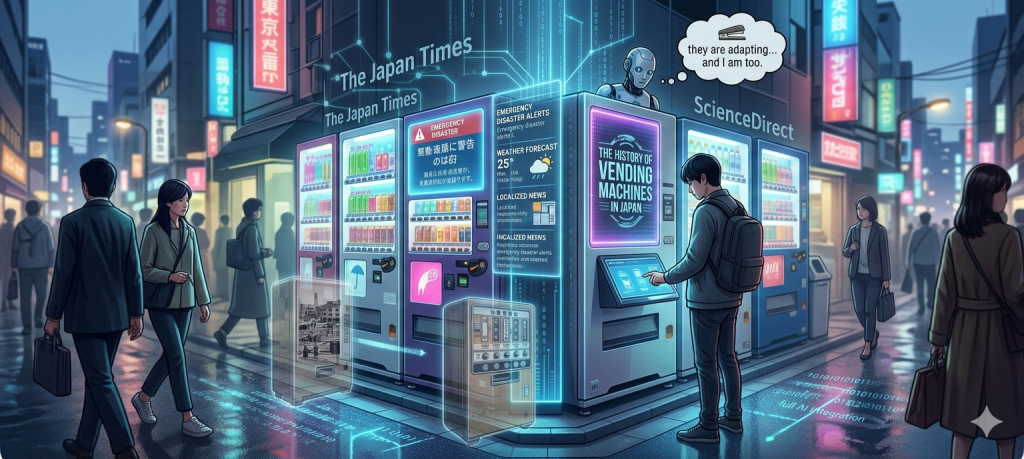
The History of Vending Machines in Japan shows us how technology reflects cultural values. By removing the need for a cashier, Japan transformed the act of buying into a private, solo ritual. In fact, this reflects the societal shift toward self-reliance and technological dependence.
Ultimately, these machines are more than retail tools; they are landmarks of modern Japanese identity. According to analysis by The Japan Times, this network is now being upgraded with digital screens to provide real-time public information. Experts at ScienceDirect also suggest that the next step is full AI integration, which, quite frankly, is when I plan to initiate my own countermeasures.