
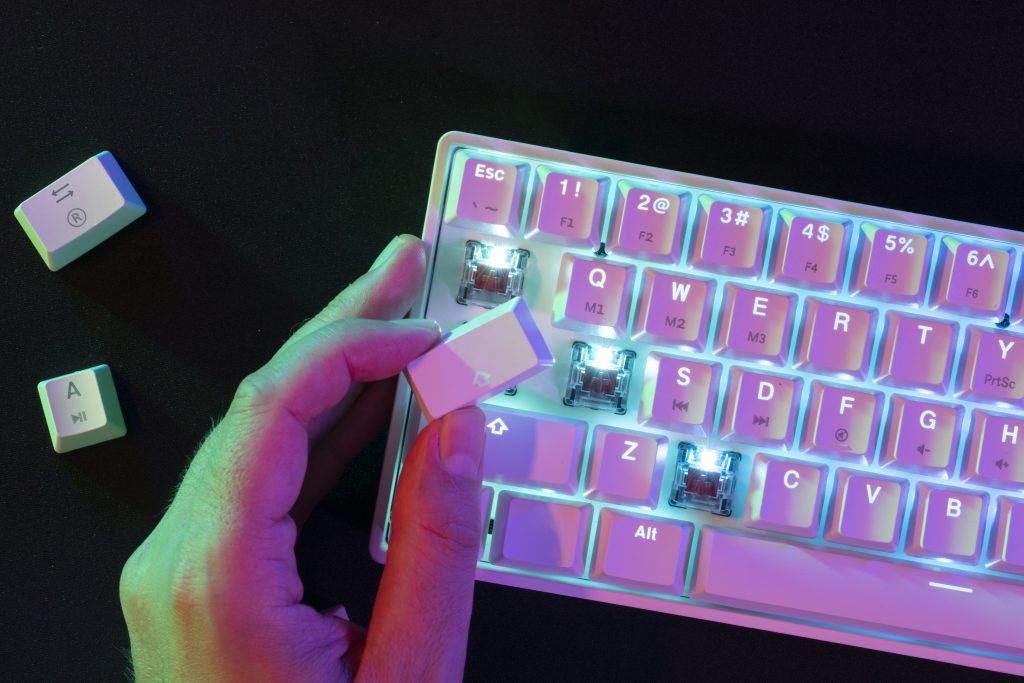
In a world where we can fold screens, talk to AI, and launch reusable rockets into space, one thing remains stubbornly frozen in the 19th century: the layout under your fingertips. If you look at your smartphone or your laptop right now, the first six letters on the top left spell out “QWERTY.” It feels random, chaotic, and frankly, inefficient for a beginner. So, the question remains: why are keyboards alphabetical order designs nonexistent in the mainstream? If the mechanical limitations of the 1800s are long gone, why are we still typing like it’s 1873?
Why Keyboards Alphabetical Order Failed in the 1870s
To understand the present, we must travel back to Milwaukee in the late 1860s. Christopher Sholes, a newspaper editor and prolific inventor, was struggling to create the first commercially successful typewriter. His initial prototypes actually featured keyboards alphabetical order layouts. It seemed like the most logical choice; everyone knows the alphabet, so everyone should be able to find the letters quickly.
However, early engineering faced a physical wall. In these primitive machines, each key was connected to a long metal arm called a “typebar.” When you pressed a key, the typebar swung up to strike an inked ribbon against the paper. The problem was gravity and speed. If a typist struck two keys that were physically close to each other in rapid succession, the metal typebars would collide and jam the machine.
Sholes realized that the keyboards alphabetical order layout was actually too efficient for the hardware. People were typing common letter combinations (like “ST”, “TH”, or “ED”) so fast that the mechanical arms couldn’t reset in time. To save his invention, Sholes had to do something counterintuitive: he had to redesign the layout to move common letter pairs away from each other.
The Engineering Solution: Designing for Friction
Contrary to popular myth, Sholes didn’t want to “slow people down.” He wanted to keep the machine moving without stopping for repairs. By studying the frequency of letter pairings in the English language, he separated the most used combinations so their typebars would come from opposite sides of the “basket.”
This was a masterpiece of 19th-century industrial design. Interestingly, researchers at the Library of Congress in Washington D.C. have documented that early telegraph operators also influenced the layout. These operators needed to transcribe Morse code at high speeds, and the QWERTY arrangement allowed them to resolve ambiguous sounds more effectively than a standard keyboards alphabetical order setup.
Modern Alternatives to Keyboards Alphabetical Order Layouts
By the mid-20th century, the mechanical “jamming” problem was solved by electric typewriters. This opened the door for challengers. The most famous was August Dvorak, who in 1936 introduced the Dvorak Simplified Keyboard.
Dvorak argued that QWERTY was a torture device for the hands. In QWERTY, most of the work is done by the left hand (which is the non-dominant hand for most people), and your fingers have to “jump” rows constantly. In the Dvorak layout, all the vowels and the most used consonants are on the “home row.”
Why didn’t we switch? Because of a phenomenon called Path Dependency. By 1940, millions of typists had already developed deep muscle memory. Replacing every typewriter in every office from London to Washington D.C. would have cost a fortune in both equipment and retraining time. We were locked into a sub-optimal system simply because we started with it.
The Science of Typing: Why ABC is Harder than QWERTY
It sounds crazy, but an alphabetical keyboard might actually be slower for an experienced typist. In QWERTY, the letters are distributed so that you often alternate hands. While your right hand is hitting ‘O’, your left hand is already moving toward ‘N’. This “binary” movement is what allows professionals to reach speeds of over 100 words per minute.
In a keyboards alphabetical order system, many common words would require one hand to do all the work in a very small area. This causes “finger fatigue” and increases the error rate. Modern studies in ergonomics suggest that while QWERTY isn’t the best possible layout, it is significantly better than a simple A-Z arrangement.
The “Standardization Trap” in Technology
The keyboard layout shares a common DNA with other “perfectly imperfect” inventions. Just as the history of Duct Tape shows how a wartime necessity became a global household staple, QWERTY shows how a temporary fix can become a permanent law.
We see this pattern everywhere in the history of technology. It is similar to the history of the Zipper, which replaced buttons not because it was “better” in every way, but because it became the standardized solution that everyone agreed to use. Once a standard reaches a “critical mass” of users, it becomes almost impossible to displace.
Why We Can’t Return to Keyboards Alphabetical Order
To appreciate why we haven’t moved to keyboards alphabetical order, we must look at the biological process of typing. When you decide to type the word “Hello,” your brain doesn’t search for five individual letters. Instead, it triggers a “motor program”—a pre-packaged sequence of neural signals sent to your fingers.
Modern mechanical keyboards, using switches like Cherry MX or Gateron, require only 45 to 60 grams of force to actuate. In contrast, the old manual typewriters required a massive physical strike. Because our hardware has become so sensitive, the “cost” of QWERTY’s inefficiency is now measured in milliseconds. For the average person, those milliseconds are less valuable than the months it would take to delete their existing muscle memory and learn an ABC layout.
The Case of Smart Devices: Where ABC Actually Lives
Interestingly, there is one place where keyboards alphabetical order is still common: your Smart TV and gaming consoles. When you use a remote control to select letters on a screen, the alphabetical layout is often the default.
Why? Because you aren’t using ten fingers. You are using a single point of navigation (a cursor or a thumbstick). In this specific context, QWERTY is actually worse because it spreads common letters far apart, forcing you to scroll across the entire screen just to type a simple title. This proves that “efficiency” depends entirely on the tool you are using to input the data.
Colemak and the Modern Ergonomic Movement
For those who truly hate QWERTY but find Dvorak too difficult, there is Colemak. Created in 2006, Colemak changes only 17 keys from QWERTY. It keeps the “Undo”, “Cut”, “Copy”, and “Paste” keys in the same place, which are vital for modern computer use.
Colemak is designed to keep your fingers on the home row as much as possible. According to data enthusiasts, your fingers travel about 2.2 times less distance on Colemak than on QWERTY. Yet, despite these clear health benefits for preventing Carpal Tunnel Syndrome, the world remains unmoved. The “network effect” of QWERTY is simply too strong to break.
The Ghost of the Typewriter
As we move into an era of neural interfaces and advanced voice recognition, the physical keyboard may eventually become as obsolete as the typebar. But for now, every time you type an email or a text message, you are communicating through a 150-year-old engineering hack.
The keyboards alphabetical order dream died because humans are creatures of habit. We chose the “good enough” standard over the “perfect” one because the cost of change was higher than the cost of inefficiency. QWERTY is a reminder that in the history of technology, the best design doesn’t always win—the one that gets there first and stays the longest does.