
Understanding blood types and compatibility is not just a biological curiosity; in fact, this vital information saves lives. Although we all appear the same on the outside, our blood cells contain specific antigens that determine who receives our help in an emergency. If you are interested in how technology intersects with human biology, you might also enjoy reading our post on The History of AI.
Understanding blood types and compatibility systems
Two main factors define your blood type:
- The ABO system: This determines whether you have A, B, both (AB), or no (O) antigens.
- The Rh Factor: This indicates whether your blood has (+) or lacks (-) the protein known as the D antigen.
By combining these factors, scientists categorize blood into eight primary groups: A+, A-, B+, B-, AB+, AB-, O+, and O-.
How blood types and compatibility affect donation
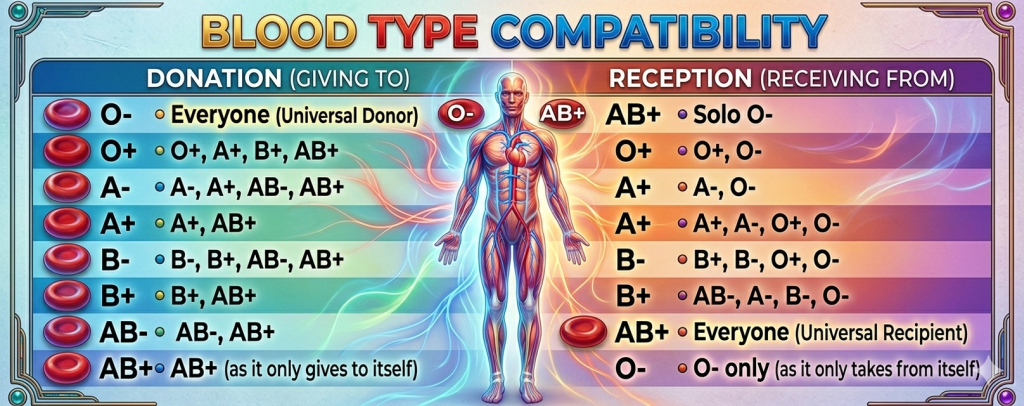
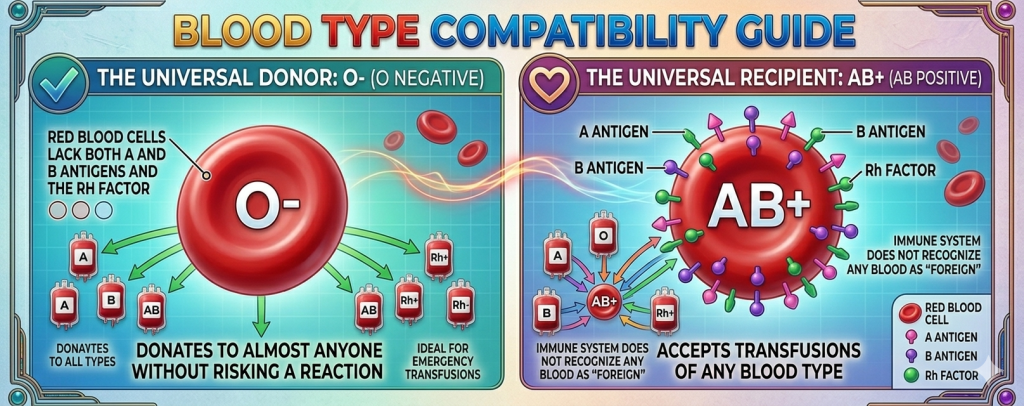
The golden rule of transfusion prevents a recipient’s immune system from attacking donated blood. Consequently, the following table provides a clear breakdown of blood types and compatibility:
Key Concepts for Understanding Donation
The Technological Frontier: Laboratory-Grown Blood
Scientists actively pursue the creation of a universal blood type manufactured in a laboratory, with Japan leading this research. The objective involves developing blood that lacks a blood group entirely, thereby eliminating the need for prior compatibility testing. For more on how Japan approaches technological innovation, see our article on The History of Vending Machines in Japan: The Country That Automates Everything.
However, researchers face significant scientific challenges:
- Limited functions: Currently, laboratory blood struggles to replicate critical functions, such as efficient oxygen transport.
- Industrial scalability: Production presents the greatest challenge; because it requires manufacturing billions of blood cells on an industrial scale to achieve viability.
- Safety and complexity: Natural blood remains extremely complex, since it transports essential hormones and proteins. Furthermore, the safety of synthetic blood lacks full proof, as it potentially provokes adverse reactions in the body.
Even if society applies this technology, initial access would remain limited; thus, it would not reach everyone immediately. For detailed, verified medical guidelines on blood donation, you can visit the World Health Organization’s Blood Safety portal.
A Note on Blood Complexity
It is important to note that, while this guide covers the main groups, medical science has recently documented new blood group systems and variants through advanced genetic studies. Nevertheless, the general public rarely understands these systems, and standard protocols exclude them.
Why Is Donating Important?
Laboratories cannot manufacture blood for mass clinical use. For this reason, altruistic donation serves as the only source of this resource. By donating, you help patients undergoing surgery, and you also support those with chronic anemias, cancer patients, and accident victims.
In conclusion, knowing your blood group and donating regularly serves as an act of social responsibility. If you happen to be O-, your contribution remains especially critical to the healthcare system.